Across the world, recycling plants are facing increasing pressure to improve recovery rates, reduce labor costs, and meet stricter e
nvironm
ental regulations. Traditional recycling methods that rely heavily on manual sorting and standalone equipment can no longer satisfy the growing demand for high-purity recycled materials.
Today, Smart Recycling Systems are transforming the recycling industry by integrating artificial intelligence, automated sorting equipment, and digital production management into one intelligent solution. These systems help recycling companies recover more valuable materials while improving operational efficiency and profitability.
Why Traditional Recycling Systems Are No Longer Enough
Many conventional recycling facilities still operate with independent machines and manual sorting processes. While these methods can recover valuable materials, they often suffer from several challenges:
- High labor costs
- Inconsistent sorting accuracy
- Limited production capacity
- Equipment operating independently
- Poor data visibility
- High maintenance requirements
As recycling industries continue to evolve, companies need smarter production lines that can automatically identify, separate, and monitor recyclable materials with minimal human intervention.
What Is a Smart Recycling System?
A Smart Recycling System is an integrated recycling solution that combines multiple sorting technologies into one automated production line.
Instead of operating several independent machines separately, all equipment works together under one intelligent control platform. Advanced technologies such as AI image recognition, X-ray detection, machine vision, and PLC automation allow the entire recycling process to operate continuously with minimal manual operation.
The result is higher sorting purity, greater resource recovery, and lower operating costs.
How AI Improves Recycling Efficiency
Artificial intelligence has become one of the most important technologies in modern recycling plants.
Using AI algorithms together with high-precision sensors and X-ray inspection, the system can automatically identify different materials based on their density, atomic composition, color, and shape.
Typical recyclable materials include:
- Copper
- Aluminum
- Stainless steel
- Brass
- Zinc alloys
- Glass
- Stone
- Plastics
- Other non-ferrous metals
Compared with manual sorting, AI-powered systems provide more consistent results, significantly reduce labor dependency, and support continuous 24-hour operation.
Fully Automated Production from Start to Finish
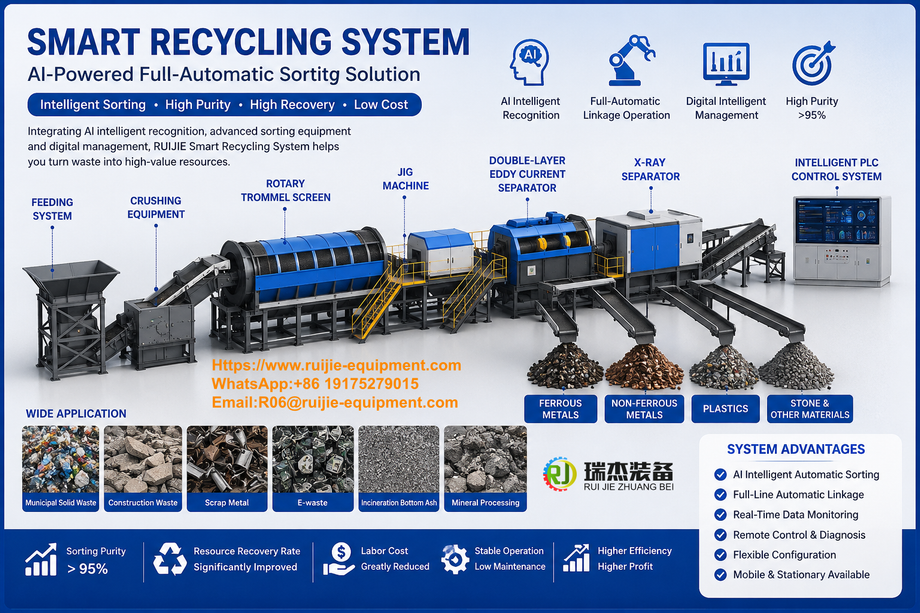
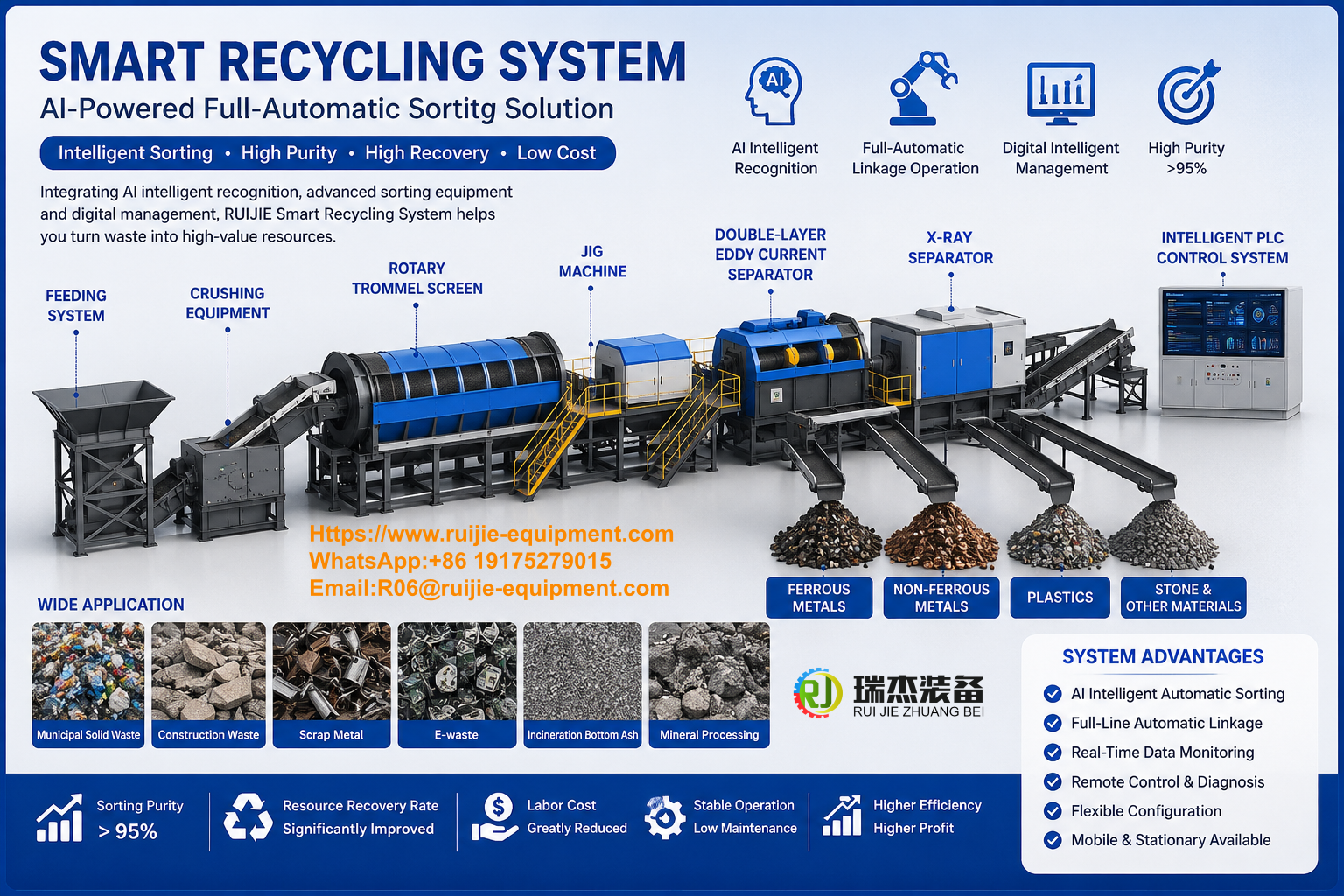
Modern Smart Recycling Systems integrate every stage of the recycling process, including:
- Feeding
- Crushing
- Screening
- Gravity separation
- Eddy current separation
- X-ray sorting
- Finished material discharge
Because every machine communicates through a centralized control system, operators can start or st
op the entire production line with a single command. Intelligent parameter adjustment also helps reduce blockages, equipment wear, and unexpected downtime.
For projects that require mobility, crawler-mounted solutions can be deployed directly at construction sites, demolition projects, mining areas, or slag treatment facilities.
Digital Management Makes Recycling Smarter
Beyond material separation, digital management has become another key advantage of intelligent recycling systems.
Modern control systems continuously monitor production data such as:
- Processing capacity
- Material recovery rate
- Sorting accuracy
- Equipment status
- Energy consumption
- Alarm records
This data allows operators to optimize production, schedule maintenance proactively, and make informed management decisions based on real-time information.
Where Smart Recycling Systems Are Used
AI-powered recycling systems are suitable for a wide variety of industries, including:
- Municipal solid waste (MSW)
- Construction and demolition waste
- Incineration bottom ash (IBA)
- Scrap metal recycling
- Electronic waste (E-waste)
- Mineral processing
- Industrial solid waste recycling
As demand for high-purity recovered materials continues to increase, intelligent sorting systems are becoming an essential investment for modern recycling facilities.
RUIJIE Smart Recycling Solution
To meet these industry challenges, RUIJIE has developed a complete Smart Recycling System that integrates feeding equipment, crushing systems, trommel screens, jig machines, eddy current separators, X-ray sorting equipment, and intelligent PLC control into one coordinated production line.
The modular design allows each system to be customized according to different materials, production capacities, and recovery objectives. Whether processing municipal waste, construction debris, scrap metals, or mineral resources, RUIJIE provides tailored solutions that help customers improve recovery efficiency while reducing operating costs.
Looking Ahead
The recycling industry is moving toward greater automation, intelligence, and data-driven management. Smart Recycling Systems are no longer just an upgrade to existing production lines—they represent the future of sustainable resource recovery.
Companies that invest in AI-powered recycling technologies today will be better positioned to achieve higher recovery rates, improve operational efficiency, and remain competitive in an increasingly demanding market.
If you are planning to upgrade your recycling facility or build a new intelligent sorting plant, exploring a Smart Recycling System could be the first step toward a more efficient and sustainable operation.
Https://www.ruijie-equipment.com
WhatsApp: +86 19175279015
Email: R06@ruijie-equipment.com
Location : Migrant Worker Pioneer Park, Minle Town, 525137 Beiliu,
Contact : Sorting sortingmachine, +86 17878005688



 42952 Second hand goods
 91706 Search / buy